EVENTS about careers insights TECH BLOG contact JA | EN ZH |

Episode 2. The World Compiler: A Noitom Robotics Blueprint for the Next Infrastructure Layer of Physical AI

Compared to conventional AI systems, embodied intelligence necessitates a considerably richer and more diverse set of data modalities...

read article

Episode 1. ModalityNet: The Art of Modalities in Human-Centric Data

Compared to conventional AI systems, embodied intelligence necessitates a considerably richer and more diverse set of data modalities...

read article

Episode 2. The World Compiler: A Noitom Robotics Blueprint for the Next Infrastructure Layer of Physical AI

Jun 2026

Dr. Tristan Ruoli Dai, Founder & CEO Noitom Robotics

1. The Missing Foundation of Physical AI

Every wave of AI has been unlocked by a new learnable representation. Language became computable through Word2Vec [1], BERT [2], and GPT-3 [3], and multimodal systems such as CLIP [4], Flamingo [5], PaLM-E [6], and GPT-4V [7] then fused language with images and video. But these breakthroughs were never about architectures alone — each was preceded by a long process of turning reality into machine-readable form.

Language followed a chain of representation:

Human Knowledge → Writing → Books → Digital Text → LLMs

Vision followed the same trajectory, becoming learnable only after it was systematically captured and organized through infrastructures such as ImageNet [8]:

World → Photography → Images → ImageNet → Vision Models

Physical intelligence has not yet undergone this transformation. Human movement, manipulation, touch, coordination, tool use, and interaction generate enormous knowledge every day, yet — unlike language and vision — these experiences are rarely captured, structured, or represented in forms machines can learn from. The chain still has a hole in the middle:

Physical Interaction → ??? → Learnable Representation

Our thesis is this: the bottleneck of Physical AI is not data scarcity but learnability scarcity. The physical world already contains vast embodied intelligence; what it lacks is the representational infrastructure that turned language into text and vision into images. And that infrastructure is not built by collecting ever more. The move is compilation — using compact, fully structured corpora to make vastly larger, weakly structured ones learnable. That asymmetry, not raw volume, is what will turn physical experience into a substrate machines can learn from.

The gap is increasingly visible across the field. Robot policies such as RT-2 [9] and Diffusion Policy [10], cross-embodiment datasets such as Open X-Embodiment [11], world models such as Genie [12] and Cosmos [13], and self-supervised video representations such as V-JEPA [14] all point to the same reality: model capability is advancing far faster than our learnable representations of physical reality. Before Physical AI can scale the way language AI did, the physical world itself must be made learnable. This demands a new infrastructure layer: the World Compiler.

2. Learnability as Infrastructure

Every major wave of AI has been preceded by a wave of representational infrastructure. Language AI was enabled by Wikipedia, Common Crawl [15], books, and web-scale corpora; vision AI by ImageNet [8], COCO [16], and Open Images [17]; semantic understanding by FrameNet [18], PropBank [19], and ConceptNet [20]. In each case the critical innovation was not only model architecture but the existence of a learnable substrate — and intelligence often emerged from the organization of relationships among observations, not the observations alone.

There is an obvious objection here: language AI scaled mostly on raw text — Common Crawl, not FrameNet — so didn't scale, rather than structure, win? The resolution is that text is not raw at all. Written language is already the output of a millennia-long human compiler: speech and thought encoded into discrete, symbolic, self-describing form that carries syntax, semantics, and reference on its surface. The internet did not hand us reality; it handed us reality already compiled into symbols. Physical interaction has no such pre-existing compiled stream — you cannot scrape contact, force, intent, or causality the way you scrape text, because no one ever wrote them down. This is exactly why language could scale on raw data while Physical AI cannot, and why physical reality needs a compiler of its own.

Physical AI still lacks an equivalent of ImageNet [8], Common Crawl [15], or FrameNet [18] for physical reality. Much of the current discussion frames the problem as data scarcity, assuming that more data straightforwardly yields better models. But raw data does not automatically become learnable intelligence. Large-scale egocentric video such as Ego4D [21] provides valuable observation, yet observation is not structured understanding: video records appearance and motion while leaving intent, contact, causality, success, and failure implicit. Simulation and synthetic data, likewise, express assumptions about the world rather than the full richness of human experience; they can model physical rules but cannot by themselves supply the embodied priors humans acquire by living in the real world.

Physical intelligence resides in relationships — between body and environment, hand and object, action and consequence, intention and outcome. Without them, data stays descriptive; with them, data becomes learnable. The bottleneck, then, is not volume but compilation: whether physical experience can be transformed into representations that support learning, transfer, prediction, planning, and embodiment.

To make this precise, we define learnability as the degree to which a representation of physical interaction supports machine learning along four dimensions:

  1. Supervision — the representation exposes explicit, structured targets (states, contacts, forces, task stages) to define learning objectives on, rather than only raw pixels.
  2. Grounding of success and failure — outcomes, causality, and physical consequence are represented, so models can learn why an interaction succeeds or fails, not merely what it looked like.
  3. Predictability — the representation supports predicting future physical states and the effects of actions.
  4. Transferability — the captured intelligence can be retargeted across embodiments, rather than being locked to a single sensor rig or robot body.

Under this definition, learnability is a property of representational structure, not data volume. Ten million hours of raw video can score low on every dimension, while a smaller, fully reconstructed multimodal corpus can score high. This is why the path to Physical AI runs through compilation rather than accumulation.

3. The World Compiler

Throughout computing, progress has come from abstraction layers: compilers turn source code into executable programs, databases turn information into structured knowledge, operating systems turn hardware into programmable platforms. Physical AI needs a comparable layer — a World Compiler that transforms physical interaction into machine-learnable representations.Your Attractive Heading

Its purpose is not to collect data but to organize reality: to capture interactions among humans, objects, and environments, synchronize multiple modalities, reconstruct physical states and behaviors, and convert continuous experience into representations that support learning, planning, simulation, and evaluation. The output is not raw data but structured physical intelligence.

The strategic logic is inescapable: model architectures evolve rapidly — transformers, diffusion models, reinforcement learning, world models, vision-language-action (VLA) architectures, and approaches not yet invented. Models evolve. Reality does not. A World Compiler therefore sits beneath competing model architectures and remains valuable regardless of how downstream systems change. Its purpose is not to predict which paradigm will win, but to make physical reality learnable for all of them.

This also reframes how a dataset should be built. The decisive question for ModalityNet is not how much data it holds, but whether compact, fully structured corpora can be used to compile large, weakly structured ones into learnable form — the asymmetry at the heart of the next section.

4. ModalityNet: Three Axes of Physical Learnability

ModalityNet is Noitom Robotics' implementation of the World Compiler. Its goal is not a larger dataset but a learnable substrate: a dataset stores observations, a World Compiler organizes reality. The name deliberately echoes ImageNet [8] — where ImageNet organized visual reality into a learnable substrate for vision, ModalityNet organizes physical reality across multiple modalities into a learnable substrate for Physical AI. Its design draws three lessons from past infrastructure: ImageNet [8] showed the value of organizing structure, FrameNet [18] of organizing interaction and relationships, and Common Crawl [15] of capturing distribution — the natural, long-tail spread of data at web scale.

But the most important idea in ModalityNet is not the three axes themselves; it is that they do not share the same level of learnability — and that this asymmetry is the design. Compact, fully structured corpora act as a compiler toolchain that raises the learnability of a much larger, weakly structured one. This mechanism is exactly what determines where ModalityNet sits in the data pyramid.

Where ModalityNet Fits in the Data Pyramid

Episode 1 of this series laid out the embodied data pyramid in full. One property decides everything that follows — the gap it leaves in the middle: a tiny, perfectly embodiment-aligned apex of teleoperation data, and a vast but loosely aligned base of internet and simulation data, with little in between. Even lightweight in-the-wild collection does not fill it: handheld rigs like UMI [22] are bound to a single gripper, short on real dexterity, and capped in scale by the very capture device they depend on.

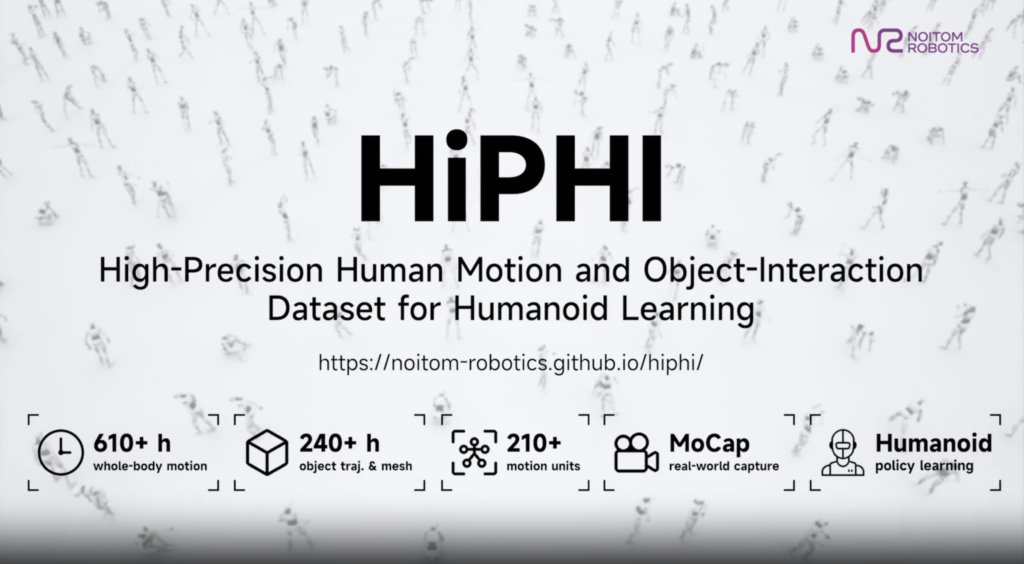
This missing middle is exactly where ModalityNet lives: its three datasets occupy the two intermediate layers the pyramid never had. HiPHI (High-Precision Human Interaction) — captured in instrumented studio and factory environments as HiPHI-MOV (Motion with Object and Vision) and HiPHI-OM (Omni-Modal interaction) — sits just below the apex, inheriting near-teleoperation alignment and precision. ITW (In-The-Wild) sits just above the base, contributing internet-scale diversity and long-tail coverage. Holding both inside a single representation — and using the high-precision studio and factory layers to compile the wild one — is what ordinary pipelines never do.

These are also the two layers where scarcity — and therefore value — is concentrated. Both are the hardest data in the pyramid to produce, and demand for them is climbing fast: on the HiPHI side, Noitom Robotics' production already runs on the order of 100,000 hours per year and still falls far short; on the ITW side, demand has reached the order of a million hours this year alone, with broad expectations of at least two orders of magnitude more. That is what makes these the most valuable layers to own — volume driven by demand, margin protected by scarcity — the best-balanced point in the whole pyramid between the two.

HiPHI-MOV: Motion Prior

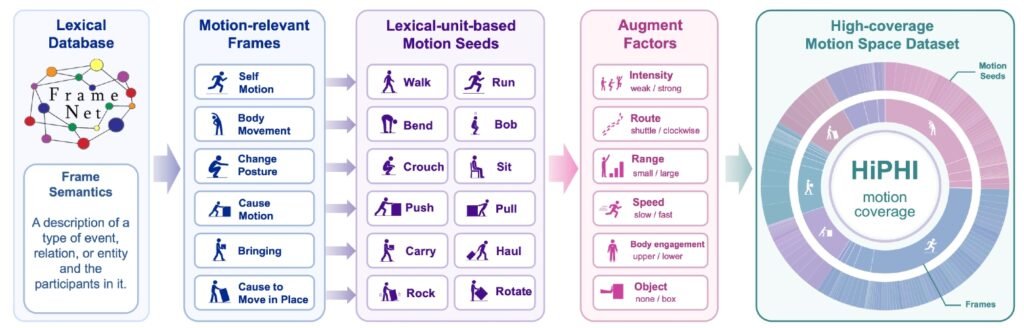
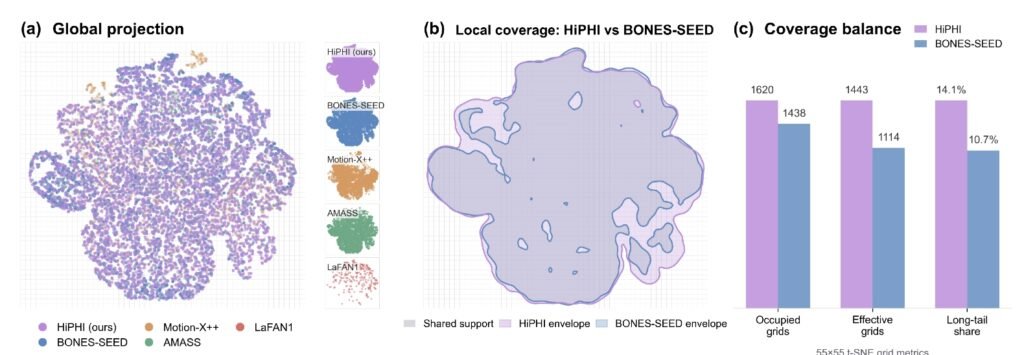
HiPHI-MOV captures high-fidelity human motion together with object and visual context — posture, locomotion, coordination, reaching, transitions, and object-relative behavior. It records short-horizon whole-body motion through a hybrid optical–inertial-EMF capture stage, exported as BVH (Biovision Hierarchy) skeletons together with multiple end-effector 6-DOF poses (following the SMPL-X body-model convention [23]), and deliberately includes loco-manipulation of large objects rather than tabletop motion alone. Action coverage is driven systematically — FrameNet [18] verb primitives expanded into scripts — and benchmarked against corpora such as AMASS [24], LAFAN1 [25], and Motion-X++ [26], where t-SNE (t-distributed stochastic neighbor embedding) coverage shows it spanning regions those datasets miss.

It answers a fundamental question: how do humans move through the physical world? By organizing movement into a learnable representation of physical behavior, HiPHI-MOV provides a motion foundation for humanoids, embodied agents, and physically grounded world models.

HiPHI-OM: Interaction Prior

HiPHI-OM captures high-precision omni-modal interaction — dexterity, manipulation, contact, hand–object interaction, and task execution. It synchronizes full-body and finger motion, object mesh tracking, hand tactile and pressure signals, and ego- and side-view RGB-D, with hand–object tracking held to millimeter error. These are exactly the signals that decide success and failure yet stay invisible in ordinary video, where contact, timing, and force leave no explicit trace.

It answers a second question: why do interactions succeed or fail? By revealing the hidden structure of interaction, HiPHI-OM provides a foundation for manipulation learning, reward inference, affordance understanding, and grounded world modeling.

ITW: Real-World Distribution Prior

ITW captures human behavior in natural environments. It is acquired with lightweight and sparse wearables — stereo (binocular) ego vision as the primary stream, sparse body sensing from inertial or electro-magnetic body straps, and audio — trading studio- and factory-grade completeness for scale and reach. Studio and factory systems provide precision and control; ITW provides diversity, uncertainty, and long-tail variation, and is by far the largest of the three corpora.

It answers a third question: does learned behavior remain valid in the real world? By preserving the true distribution of physical reality rather than only carefully designed demonstrations, ITW provides the grounding required for robust Physical AI.

Learnability Is Not Uniform Across the Three Axes

As previewed, the three axes do not share the same learnability — by design. HiPHI-MOV and HiPHI-OM are produced through complete-dimension, multimodal acquisition: motion, contact, force, object state, and visual context are captured simultaneously and digitized into aligned, synchronized streams. Because every signal has explicit physical meaning and the relationships among signals are recorded rather than inferred, these representations score high on supervision, grounding, predictability, and transferability.

ITW is fundamentally different. It is where real-world scale and true distribution live, but it is dominated by subjective, first-person stereo ego vision — and stereo is exactly the point: the imagery contains depth implicitly, but not as the explicit, structured, metric representation a model can directly learn from. On its own ITW is therefore low-learnability: depth, contact, force, and full-body state are present only implicitly or partially, must be reconstructed, and large portions of the body or scene are occluded. Its compensating strength runs in exactly the opposite direction: because it is captured in the wild rather than in a studio or factory, ITW alone spans the real visual distribution — strong visual generalization precisely where the studio and factory corpora are weak.

Scored against the four learnability dimensions defined earlier — and against a fifth property, visual generalization, that deliberately runs the other way — the asymmetry is concrete rather than rhetorical, and it cuts in both directions:

HiPHI-MOVHiPHI-OMITW (raw)
SupervisionHIGH
explicit skeleton and end-effector targets
HIGH
contact, force, object state
LOW
only implicit pixels; must be reconstructed
Grounding of success/failureMEDIUM
motion captured without explicit outcome
HIGH
contact and force expose why tasks succeed or fail
LOW
outcomes rarely explicit
PredictabilityHIGH
clean future-state targets
HIGH
physical effects of actions
LOW/MEDIUM
partial, occluded states
TransferabilityHIGH
retargets across embodiments
HIGH
retargets onto dexterous hands
MEDIUM
diversity aids robustness, but structure is weak
Visual generalizationLOW
controlled studio/factory domain
LOW
controlled studio/factory domain
HIGH
real-world visual distribution

This asymmetry defines ModalityNet's central technical program:

Use the high-learnability MOV and OM corpora to train the models and refine the algorithms that raise the learnability of the high-volume, low-learnability ITW corpus.

The reverse direction matters just as much. The studio and factory corpora deliberately have no visual generalization: captured under controlled subjects, objects, and lighting, they are not built to span the visual world, and asking them to would be a category error. ITW supplies exactly that missing axis — the real-world visual distribution that no instrumented studio or factory can manufacture. The relationship is therefore not a hierarchy but a division of labor: render unto the studio and factory what demands precision and modality completeness, and unto the wild what demands distribution and visual breadth. ModalityNet's value is not any single corpus but the complementary chain linking them, and that chain is where the difficulty really lives: defining the data, defining the methods that make heterogeneous datasets reinforce one another, and training the models that turn them into learnable representations is a far higher bar than collecting or labeling. It is also Noitom Robotics' moat — few data or annotation vendors can define the data, define how the pieces complement one another, and train the models as a data usability validation that close the loop.

Worked example 1 — Compiling explicit depth and hand state out of stereo ego vision

Stereo ego vision already contains depth — but only implicitly, not as the explicit, metric, per-pixel representation a model can learn from. Using HiPHI-OM as the core supervision — complemented by public datasets, which only sharpen the models — we train depth- and hand-pose-estimation models that turn that implicit signal into precise, structured depth and accurate hand poses directly from raw ego-vision frames; HiPHI-OM supplies the fully observed hand–object and contact ground truth that ITW never records. Applied at scale to ITW footage, these models reconstruct wrist and hand motion as hand end-effector trajectories. Vast quantities of ordinary ego video thereby acquire the structured geometric and manipulation signals they only latently held — becoming action labels that can directly pretrain VLA or world models. This is what we mean by compiling ITW into learnable form.

Worked example 2 — Completing missing body dimensions with a motion prior

Using the large HiPHI-MOV corpus, we train motion-prior foundation models (analogous to NVIDIA's Kimodo [27], a kinematic motion diffusion model controllable from sparse joint constraints, and SONIC [28], a whole-body motion-tracking control foundation model trained on large-scale motion capture) that encode strong priors over how human bodies move and coordinate. Applied to ITW, these models perform dimensional completion: when the torso and lower limbs are entirely unseen, or only fragmentary glimpses are available, the motion prior still estimates a coherent full-body pose. Reality is observed only partially; the motion prior reconstructs the rest in a physically plausible way.

A fair objection remains: the compiled labels are themselves model outputs, so how do we know they are right? The check is built into the data. Because HiPHI-MOV and HiPHI-OM are fully observed, ground-truth-grade corpora, we can mask selected dimensions and modalities to degrade them down to an ITW-like input, run the very same completion and augmentation models, and score their output against the withheld ground truth. The complete-dimension corpora that train the compiler therefore also validate it: reconstruction accuracy is measured directly rather than assumed, and a model is trusted on real ITW only to the degree that it recovers the masked HiPHI ground truth.

Validation: From Data to Proof

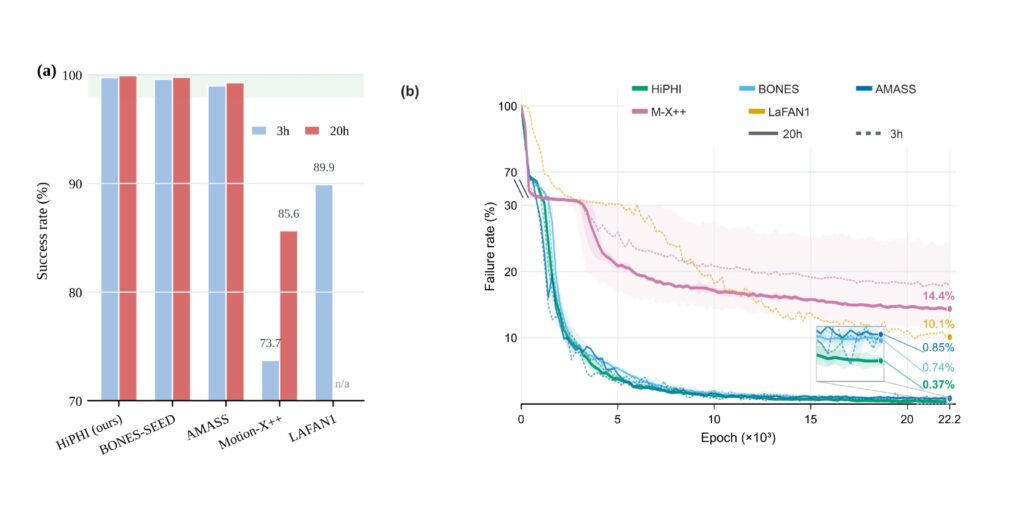
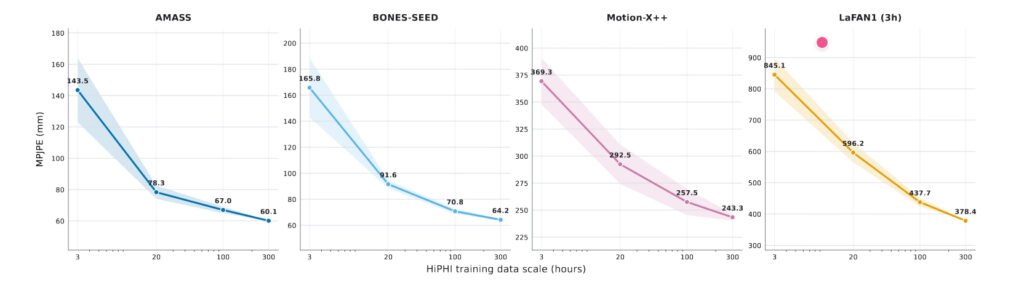
A compiler is only as good as the programs it produces, so we treat models trained on ModalityNet — not assertions — as the real test of the thesis. Validation runs on two tracks. For HiPHI-MOV: a full pipeline of cross-embodiment retargeting, reinforcement learning in simulation, and sim-to-sim and sim-to-real deployment, measuring whether downstream performance improves as the dataset scales. For HiPHI-OM: retargeting high-precision hand–object trajectories onto dexterous robotic hands — using interaction-preserving retargeting methods such as OmniRetarget [29] — to initialize VLA policies, measured against teleoperation-only baselines. The early results are already encouraging, and we will publish them in full across the upcoming installments of this series — scaling curves, sim-to-real transfer, and downstream policy performance. This article sets out the architecture; the evidence follows in the posts to come.

Across all three, ModalityNet defines one shared representation — motion structure × interaction structure × real-world distribution — within which motion, interaction, and consequence become measurable, comparable, and learnable. These are not independent datasets but components of a unified representational framework: a shared substrate for robots, world models, and future embodied foundation models alike.

5. Position in the Physical AI Stack

Physical AI is pursuing many paths — humanoids, VLA systems, world models, reinforcement learning, teleoperation, simulation, and hybrids. Yet while the ecosystem diverges at the model layer, it is converging at the representation layer, because all of these approaches ultimately learn from the same source: human physical intelligence. Humans possess the richest embodied prior available — the world's tools, environments, and workflows are built around human bodies — and billions of people generate physical intelligence every day through movement, manipulation, tool use, and problem solving. Human-centric multimodal data captures interaction itself, preserving that intelligence before it is collapsed into any single robot embodiment, simulator, or control system. Whatever the downstream path — whichever embodiment, architecture, or paradigm eventually wins — it reduces to the same irreducible factor underneath:

Human physical intelligence is the greatest common divisor of Physical AI — the one factor every embodiment, architecture, and paradigm shares. Build it once, at the human layer, and it serves them all.

This convergence is visible across the field. In robotics and embodied AI, Open X-Embodiment [11], OpenVLA [30], π0 [31], and Helix [32] increasingly emphasize broader embodiment coverage, scalable human demonstrations, and shared representations; in parallel, world-model efforts such as Genie [12], Cosmos [13], V-JEPA [14], and JEPA [33] focus on interaction, prediction, and physical grounding rather than passive observation.

This shared dependency defines the role of the World Compiler within the broader Physical AI stack:

Noitom Robotics is building the World Compiler layer. Its role is not to replace robots, world models, or foundation models, but to provide the representational substrate that connects physical reality to machine learning — a position that stays relevant regardless of which downstream architectures rise or fall. And this is not a thesis argued from the sidelines: in working with close to 100 companies across the field, we are already building this layer in production, alongside our partners.

Conclusion

One idea should outlast the rest: Physical AI will not be unlocked by accumulation alone. The decisive move is compilation — turning the embodied intelligence the world already produces into representations machines can learn from. ModalityNet is our attempt to build that compiler: compact, fully structured corpora that manufacture learnability for data at real-world scale.

This article is one installment in an ongoing series. Building on the data pyramid laid out in Episode 1, future posts will go beyond the thesis into evidence — the scaling behavior of HiPHI-MOV and HiPHI-OM, sim-to-real transfer, and the downstream policy performance that tests whether compiled data truly learns better.

None of this is work we do alone. The teleoperation, human-centric data capture, and data-alignment approaches behind it were explored hand in hand with our partners, and many of the ideas in this article emerged from that collaboration rather than being handed down from above. We intend to keep walking that road with our friends — growing together with them, and with the industry as a whole.

Our mission stays simple: make the physical world learnable.

References

[1] Mikolov, T., Chen, K., Corrado, G., & Dean, J. (2013). Efficient Estimation of Word Representations in Vector Space (Word2Vec). arXiv:1301.3781.
[2] Devlin, J., Chang, M.-W., Lee, K., & Toutanova, K. (2019). BERT: Pre-training of Deep Bidirectional Transformers for Language Understanding. NAACL.
[3] Brown, T. et al. (2020). Language Models are Few-Shot Learners (GPT-3). NeurIPS.
[4] Radford, A. et al. (2021). Learning Transferable Visual Models From Natural Language Supervision (CLIP). ICML.
[5] Alayrac, J.-B. et al. (2022). Flamingo: A Visual Language Model for Few-Shot Learning. NeurIPS.
[7] OpenAI. (2023). GPT-4V(ision) System Card. OpenAI Technical Report.
[8] Deng, J., Dong, W., Socher, R., Li, L.-J., Li, K., & Fei-Fei, L. (2009). ImageNet: A Large-Scale Hierarchical Image Database. CVPR.
[9] Brohan, A. et al. (2023). RT-2: Vision-Language-Action Models Transfer Web Knowledge to Robotic Control. arXiv:2307.15818.
[10] Chi, C. et al. (2023). Diffusion Policy: Visuomotor Policy Learning via Action Diffusion. RSS.
[11] Open X-Embodiment Collaboration. (2023). Open X-Embodiment: Robotic Learning Datasets and RT-X Models. arXiv:2310.08864.
[12] Bruce, J. et al. (2024). Genie: Generative Interactive Environments. arXiv:2402.15391.
[13] NVIDIA. (2025). Cosmos World Foundation Model Platform for Physical AI. arXiv:2501.03575.
[14] Bardes, A., Garrido, Q., Ponce, J., Chen, X., Rabbat, M., LeCun, Y., Assran, M., & Ballas, N. (2024). Revisiting Feature Prediction for Learning Visual Representations from Video (V-JEPA). arXiv:2404.08471.
[15] Common Crawl Foundation. (2024). Common Crawl Corpus. Common Crawl Foundation.
[16] Lin, T.-Y. et al. (2014). Microsoft COCO: Common Objects in Context. ECCV.
[17] Kuznetsova, A. et al. (2020). The Open Images Dataset V6. International Journal of Computer Vision.
[18] Baker, C. F., Fillmore, C. J., & Lowe, J. B. (1998). The Berkeley FrameNet Project. COLING-ACL.
[19] Palmer, M., Gildea, D., & Kingsbury, P. (2005). The Proposition Bank: An Annotated Corpus of Semantic Roles. Computational Linguistics, 31(1), 71–106.
[20] Speer, R., Chin, J., & Havasi, C. (2017). ConceptNet 5.5: An Open Multilingual Graphof General Knowledge. AAAI.
[21] Grauman, K. et al. (2022). Ego4D: Around the World in 3,000 Hours of Egocentric Video. CVPR.
[22] Chi, C., Xu, Z., Pan, C., Cousineau, E., Burchfiel, B., Feng, S., Tedrake, R., & Song, S. (2024). Universal Manipulation Interface (UMI): In-The-Wild Robot Teaching Without In-The-Wild Robots. Robotics: Science and Systems (RSS). arXiv:2402.10329.
[23] Pavlakos, G., Choutas, V., Ghorbani, N., Bolkart, T., Osman, A. A. A., Tzionas, D., & Black, M. J. (2019). Expressive Body Capture: 3D Hands, Face, and Body from a Single Image (SMPL-X). CVPR. arXiv:1904.05866.
[24] Mahmood, N., Ghorbani, N., Troje, N. F., Pons-Moll, G., & Black, M. J. (2019). AMASS: Archive of Motion Capture as Surface Shapes. ICCV.
[25] Harvey, F. G., Yurick, M., Nowrouzezahrai, D., & Pal, C. (2020). Robust Motion In-betweening (LAFAN1 dataset). ACM Transactions on Graphics (Proc. SIGGRAPH), 39(4).
[26] Zhang, Y., Lin, J., Zeng, A., et al. (2025). Motion-X++: A Large-Scale Multimodal 3D Whole-body Human Motion Dataset. arXiv:2501.05098. (Extends Motion-X, NeurIPS 2023.)
[27] NVIDIA. (2026). Kimodo: Scaling Controllable Human Motion Generation. arXiv:2603.15546.
[28] Luo, Z., Yuan, Y., Wang, T., et al. (2025). SONIC: Supersizing Motion Tracking for Natural Humanoid Whole-Body Control. arXiv:2511.07820.
[29] Yang, L., Huang, X., Wu, Z., Kanazawa, A., Abbeel, P., Sferrazza, C., Liu, C. K., Duan, R., & Shi, G. (2025). OmniRetarget: Interaction-Preserving Data Generation for Humanoid Whole-Body Loco-Manipulation and Scene Interaction. arXiv:2509.26633.
[30] Kim, M. J. et al. (2024). OpenVLA: An Open-Source Vision-Language-Action Model. arXiv:2406.09246.
[31] Black, K. et al. (2024). π0: A Vision-Language-Action Flow Model for General Robot Control. arXiv:2410.24164.
[32] Figure AI. (2025). Helix: A Vision-Language-Action Model for Generalist Humanoid Control. Figure AI Technical Blog.
[33] LeCun, Y. (2022). A Path Towards Autonomous Machine Intelligence(JEPA). Meta AI / OpenReview Position Paper.

Citation

@article{nr2026modalitynet,
title={The World Compiler: A Noitom Robotics Blueprint for the Next Infrastructure Layer of Physical AI Dr. Tristan Ruoli Dai},
author={Dr. Tristan Ruoli Dai, Noitom Robotics Team},
journal={Noitom Robotics Blog},
year={2026},
note={https://noitomrobotics.com/tech-blog/},
}

Scroll to Top